Table Of Content

The two main types of filters are low-pass filters and high-pass filters; these determine which frequencies pass through them and which do not. Understanding how these filters interact with each other is essential for creating a smooth transition between two or more drivers in a speaker system. In this article, I will take you through the step-by-step process of building your own customized speaker crossover design. I’ll go over the basics of what’s needed, including supplies and tools, as well as the more complex aspects such as circuit design and component selection. With my guidance, you’ll learn how to create an effective and reliable speaker system that meets your sound needs. Both the low pass filter and the high pass filter have a cutoff frequency of 80 Hz.
Order and filter type
In this modern day and age, it is entirely possible to construct a speaker crossover design without special tools. However, with a bit of effort and know-how, you should be able to find cost savings with your DIY speaker crossover design. With this information in hand, you can then begin selecting individual parts such as capacitors and inductors that fit within the parameters of your desired frequency range. When using an active crossover network, separate amplifier channels are required for each driver or set of drivers. Ideally, the crossover point will be the point when the two filters that make up the crossover intersect at -3dB.
How We Selected The Best Tower Speakers
They typically don't have the power handling capabilityfor woofers, where Wire-Wound Sand Cast resistors should be used. Not only will you be able to design and build your own custom speaker crossovers, but you’ll also save money in the process. Both designs have their advantages and disadvantages; however, an active crossover will provide a more accurate sound reproduction and greater control over sound quality than a passive one.
Way Speaker Kits: Tweeter, Midrange, & Woofer
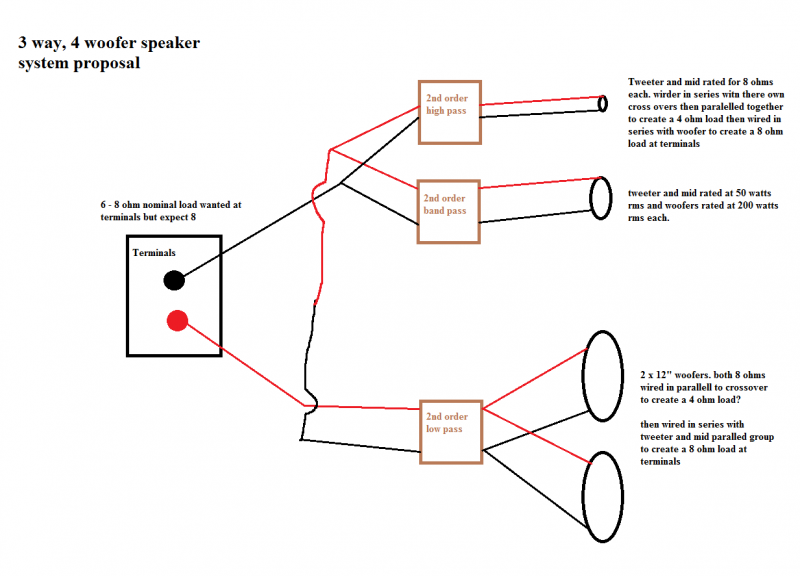
When using a passive crossover network, one amplifier channel is used to power multiple drivers. For example, to set the crossover between a woofer and a tweeter will require a low pass filter on the woofer signal and a high pass filter on the tweeter signal. This can be done with electronic components or digital signal processing (DSP). A multi-way speaker cabinet is a single enclosure that contains multiple speaker drivers. This speaker enclosure contains a woofer to reproduce low and mid-range frequencies and a tweeter to reproduce high frequencies. When two speakers are involved, this is known as a 2-way passive crossover design.
Building your own crossover design can offer a great way of saving money, but it does come with an investment of time. Now that the components are soldered together it’s time to test and adjust the design. This is where a trained ear is essential, as we analyze performance and check tolerances to make sure everything works as intended.
Way Crossover Calculator Designer
Contact us directly to learn more about archived designs for which we can provide drivers and assembled crossovers. These xover designs span decades and even include many using drivers no longer available. The optimizationprocess is applied to the low-pass, band-pass and high-pass filters and acombined response is generated. Due toresponse issues, it may be necessary to attenuate a target or move thecrossover frequency slightly to obtain a flatter response. Ultimately, it may take several rounds ofmoving crossover frequencies and even filter orders to get to an acceptablesystem response.
Ohm's law resistance
New Peaks Series Loudspeakers from YG Acoustics Look Awesome, Cost (Slightly) Less! - Audioholics
New Peaks Series Loudspeakers from YG Acoustics Look Awesome, Cost (Slightly) Less!.
Posted: Mon, 20 Jun 2022 07:00:00 GMT [source]
We also provide receivers, monitors, and other audio equipment for your professional needs. We also love the fact that these speakers have specific connections that allow you to add upward-facing Dolby Atmos speakers to further maximize your home theater setup. Sony is best known for consumer audio gear like its fantastic wireless headphones and earbuds, but the SS-CS3s are a classic for a reason. These towers have stood out from the crowd for years, delivering clear and detailed sound for a startlingly low price.

Putting it in a project enclosure
Once the components are in place, use your hot glue gun to mount them to the board. Be sure that theinductor coils are not near each other and that each one is on a different axis to eliminate"inductive coupling" (See the Crossover Guide for more info). To avoid this, if at all possible mount them at a 90° difference as shown in the diagram above or a minimum of about 3 inches. I begin by placing them at opposite corners of the box when building mine. For example, a capacitor labeled as 4.7 uF (4.7 microFarad) may have an actual of around 3.76 to 5.64 uF when measured with test equipment.
Common Uses of Speaker Crossovers
Note here that the sealedalignment in green would yield a pretty flat in-room response and is probably abetter overall choice for many listeners. However, our goal of +/-3dB from 35Hz to 20kHz and high SPL could not berealized with a sealed enclosure. Mostpeople have heard a woofer or two bottom out and it is important to considerhow much abuse a woofer can take before employing it in a design. ThePeerless woofer used in this design has a linear excursion of +/- 12.5mm. Below is a graph showing the expected coneexcursion with a 150 watt input signal with the vented enclosure in red and thesealed enclosure in green. Note thatthis power level yields over 105dB sound pressure level before the driver rollsoff for both enclosure types.
If you set the number of speakers in the calculator to one, you'll be able to choose from two additional circuits that involve a single speaker - Zobel and L-pad. Off-the-shelf bipolar capacitors sold for audio applications are normally of a sufficient working voltage. Lower voltage bipolar parts (5V, 16V, etc.) are usually used for low-voltage (line level) electronics.
You can see that there is a -3dB dip at 80 Hz in both the low and high frequency driver’s frequency response. 3dB is one half the power output, which means that when the two drivers add together they will combine to fill the hole. This will theoretically create a straight line across the graph, indicating that all frequencies are equally represented. The 2.2 cubic foot ventedcabinet tuned to 27Hz was selected even though it represents a slightmisalignment. Although a tuningfrequency of 22Hz would have resulted in flatter response, the cabinet designlimited the length of the port tube as lower tuning frequencies require longerports.